Technology for the Future
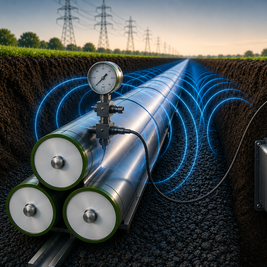
The Hivoduct technology sets new standards in power transmission: By using pressurized air as an insulating medium, it offers significant advantages over conventional cables and gas-insulated systems (GIS).
It combines the highest efficiency and maximum safety with a significantly reduced environmental impact.
Erfahren Sie in den folgenden Abschnitten mehr über die Funktionsweise und die spezifischen Vorteile dieser Learn more about how this groundbreaking technology works and its specific benefits in the following sections.
The expansion and modernization of high-voltage grids face growing challenges: environmental regulations, higher transmission capacities, increasing demands on grid stability, and the impacts on surrounding areas make traditional solutions more difficult. Underground high-voltage cables offer an alternative but come with new challenges, including thermal limitations, joints as cost drivers and weak points, magnetic field emissions, and special requirements for grounding and reactive power compensation.
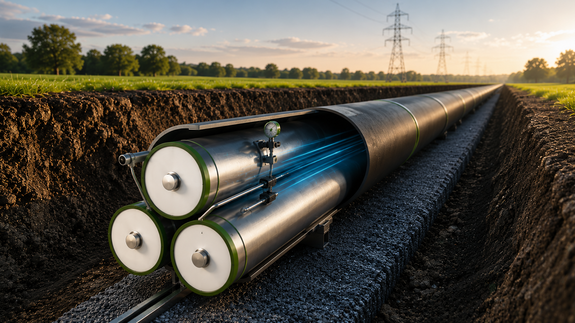
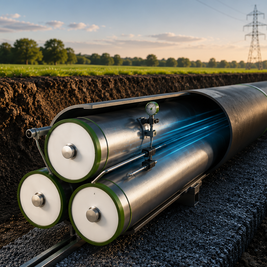
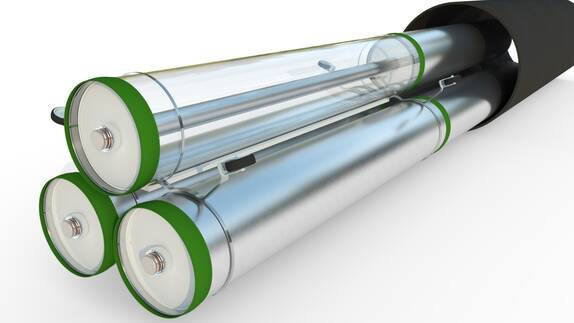
To offer grid operators a new, better option for network expansion, Hivoduct has developed the new product category "Pressurized Air Cables," setting new standards in high-voltage technology. The innovative pressurized air cables provide technical advantages over conventional overhead lines and XLPE cables. Thanks to a coaxial pipe-in-pipe arrangement and pressurized air as the insulating medium, they combine proven concepts from GIS technology with a forward-looking, environmentally friendly solution.
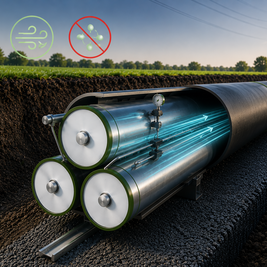
While GIS busbars and GIL (gas-insulated lines) have traditionally relied on SF6 or PFAS gas mixtures as insulating gases, there is growing global pressure to replace these climate-damaging gases. Hivoduct pressurized air cables eliminate these completely while still covering the entire medium- and high-voltage range.
The decision to eliminate SF6 required a fundamental re-development. Hivoduct has therefore developed a completely new technology that combines over 50 years of experience with gas-insulated high-voltage products with new design ideas, resulting in unique, innovative features.
Pressurized Air Cables (PAC) combine the advantages of modern high-voltage cables with a robust aluminium-enclosed design.
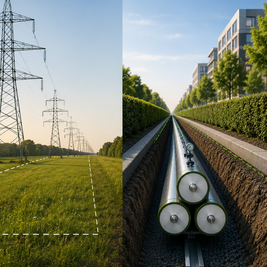
Compared with overhead lines and conventional XLPE cables, they provide significant advantages in terms of environmental impact, safety, and operational performance.
DLK: niedrigere externe Felder, weniger Eingriffe ins Landschaftsbild.
The result of this development process is the Hivoduct pressurized air cable – a groundbreaking solution for powerful, environmentally friendly, and future-proof power transmission.

We have leveraged the well-established and well-researched dielectric properties of air to develop optimal conductors, housings, spacers, and shields for operating pressures up to 10 bar.
The graphic shows the optimization of the housing and inner conductor for different lightning impulse voltages.
For a nominal voltage of 145 kV, according to IEC 62271 standards, a lightning impulse withstand voltage (BIL) of 650 kV is required. With a housing diameter of Da=210 mm, inner conductors with a diameter of about 80 mm are ideal for minimizing the field strength at the inner conductor. With a wall thickness of 10 mm from the inner conductor, this results in a conductor cross-section of approximately 2200 mm². An optimal diameter ratio of housing to inner conductor is achieved at e=2.7.
The highest electrical field stress occurs at the surface of the conductor and the shields. Details can be found here.
The key aspects of the mechanical design are:
Our extensive portfolio of pressurized air cable components enables customized solutions for a wide range of requirements:
All components of each series are freely combinable to achieve the desired technical characteristics optimally. The right selection and adjustment are part of the engineering process.
Our 3D engineering tools have all components available, allowing us to quickly create an initial layout based on customer specifications for detailed discussions.
For underground or closed applications, it is crucial to minimize the space requirements and the effort for cable ducts, installation, thermal measures, and construction work.
The key design features that enable this are:
Further details can be found in the products tab.


Hivoduct Pressurized Air Cables rely on encapsulated conductor arrangements with conductive, grounded housings to reduce electromagnetic fields to an absolute minimum.
When minimizing electromagnetic emissions is crucial, Hivoduct pressurized air cables offer the best technical solution – regardless of current strength or transmission power.
See comparisons here.
Detailed simulations demonstrate the difference between Hivoduct pressurized air cables and conventional power transmission systems.
While the magnetic field of a 1000-A overhead line conductor can still be measured at distances of up to 200 m, the field of a 145-kV pressurized air cable is limited to only a few meters. This significantly reduces electromagnetic influence on surrounding infrastructure, equipment, and sensitive installations.
The following technical factsheet presents simulation results, distance criteria (100 µT / 1 µT), and a comparison with overhead lines and XLPE cables.
Download