
 enEnglisch

Magnetic fields in pressurized air cables
Analysis of electromagnetic characteristics and comparison with conventional transmission systems
Magnetic fields in power transmission
Current-carrying conductors generate magnetic fields around them. The strength of these fields depends on the current level, conductor arrangement, and the design of the transmission system.
Pressurized air cables feature a fully metallic enclosure which, in addition to providing mechanical protection and grounding, also contributes to the reduction of external magnetic fields.
Why magnetic fields matter in infrastructure projects
When expanding modern energy infrastructure, factors such as transmission capacity, reliability of supply, environmental considerations, route planning, and public acceptance are becoming increasingly important.
Magnetic fields are among the technical characteristics of transmission systems that are often considered, particularly in urban areas, tunnels, industrial facilities, and other sensitive infrastructure projects.
Due to their fully metallic enclosed design, pressurized air cables differ significantly from overhead transmission lines and XLPE cables. The thick-walled aluminium enclosure reduces external magnetic field emissions and enables particularly compact integration into existing infrastructure.
This page explains how magnetic fields are generated, how the metallic enclosure reduces them, and the advantages of pressurized air cables in applications with increased requirements for environmental compatibility and infrastructure integration.
Key facts at a glance
How are magnetic fields generated?
Electric current generates magnetic fields
Every current-carrying conductor generates a magnetic field. This is a natural consequence of electrical power transmission and occurs in all transmission systems, regardless of whether electricity is transmitted through overhead transmission lines or cables.
The strength of the magnetic field depends on several factors, particularly the current level, the arrangement of the conductors, and the distance from the transmission system.
Magnetic fields in power transmission systems
In high-voltage overhead transmission lines and cable systems, magnetic fields are generated around the current-carrying conductors. Depending on the system design, these fields can affect the surrounding environment to different degrees.
While a portion of the magnetic fields generated by open transmission systems extends freely into the surrounding area, enclosed metallic systems can influence the field distribution and reduce external emissions.
The influence of system design
The magnitude of externally emitted magnetic fields is largely determined by the conductor arrangement and the overall design of the transmission system.
Pressurized air cables use a fully metallic enclosure which, in addition to providing mechanical protection and grounding, makes an important contribution to the reduction of external magnetic fields
Why are magnetic fields lower in pressurized air cables?
Metallic enclosure reduces field emissions
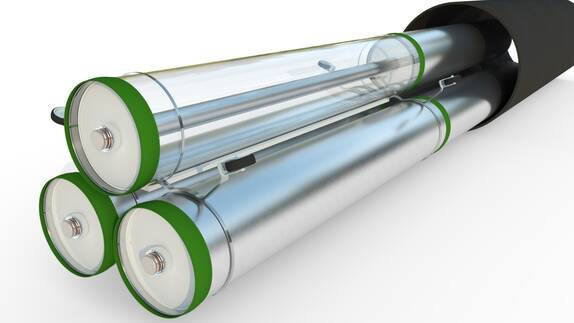
Pressurized air cables differ from many conventional transmission systems through their fully enclosed aluminium enclosure. The current-carrying conductors are located inside a pressure-resistant metallic housing that simultaneously provides mechanical protection, grounding, and electromagnetic shielding.
Magnetic field comparison: overhead transmission lines and pressurized air cables
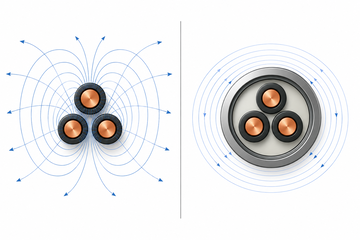
Natural compensation of magnetic fields
Due to the interaction between the current-carrying conductors and the aluminium enclosure, induced currents are generated within the enclosure. These currents create opposing magnetic fields that partially compensate for the magnetic field produced by the conductors. The effectiveness of this compensation increases with the electrical conductivity of the enclosure and the quality of its grounding. As a result, external magnetic field emissions are significantly reduced.
Reduced field emissions outside the system
While magnetic fields generated by open transmission systems can spread freely into the surrounding environment, a large portion of the electromagnetic interactions in pressurized air cables remains confined within the enclosed system. The result is significantly lower external magnetic fields along the transmission route.
Benefits of the enclosed design
The combination of a metallic enclosure and optimized conductor arrangement provides:
- Reduced magnetic field emissions
- High transmission capacity
- Integrated grounding
- Touch protection
- Compact routing
- Excellent integration into existing infrastructure
Benefits in sensitive infrastructure projects
Reduced magnetic fields where they matter most
In addition to transmission capacity and reliability of supply, modern infrastructure projects increasingly need to address environmental considerations, land use, and integration into existing developments.
Thanks to their fully metallic enclosure and reduced external magnetic field emissions, pressurized air cables are particularly well suited for applications with enhanced infrastructure compatibility requirements.
Typical applications
Pressurized air cables can offer particular advantages in:
- Urban areas
- Residential areas
- Industrial sites
- Tunnel installations
- Transportation infrastructure
- Substations
- Critical energy infrastructure
Integration into existing infrastructure
The combination of underground installation, compact routing, and reduced magnetic fields enables flexible integration into existing infrastructure. This makes it possible to create new transmission capacity without significantly affecting existing land use or sensitive landscapes.
Supporting sustainable grid development
As power grids continue to expand, there is growing demand for solutions that combine high transmission capacity with excellent infrastructure compatibility.
Reduced magnetic field emissions can make an additional contribution to the acceptance and integration of new energy infrastructure projects.
Magnetic fields and route planning
Technical characteristics in grid development
When planning new energy infrastructure, a wide range of technical and spatial requirements must be considered. These include transmission capacity, land use, maintenance access, and environmental impacts.
The characteristics of pressurized air cables enable compact routing and integration into existing infrastructure corridors.
System design as a key factor
The magnitude of external magnetic fields is determined not only by the current level but also by the design of the transmission system and the arrangement of the conductors. The metallic enclosure of pressurized air cables reduces external field emissions and thereby supports flexible infrastructure planning.
Conclusion
Reduced magnetic fields through system design
Magnetic fields are a natural part of electrical power transmission. However, their magnitude depends significantly on the design and construction of the respective transmission system.
Pressurized air cables utilize a fully metallic aluminium enclosure which, in addition to providing mechanical protection and grounding, also contributes to the reduction of external magnetic field emissions.
Benefits for modern infrastructure projects
The combination of high transmission capacity, underground installation, and reduced magnetic fields makes pressurized air cables particularly suitable for applications with increased requirements for infrastructure integration and environmental compatibility.
Particular advantages arise in:
- Urban areas
- Residential areas
- Tunnel installations
- Industrial infrastructure
- Transportation infrastructure
- Critical energy facilities
Future-ready power transmission
The demands placed on power grids continue to grow. At the same time, topics such as land use, infrastructure integration, and public acceptance are becoming increasingly important.
Pressurized air cables combine high transmission capacity with an enclosed system architecture, creating the foundation for high-performance and sustainable energy infrastructure.
Technical documents
Factsheets and technical documents
Frequently asked questions (FAQ)
Do pressurized air cables generate magnetic fields?
Why are magnetic fields lower in pressurized air cables?
Are pressurized air cables fully shielded?
What is the role of the aluminium enclosure?
Are pressurized air cables suitable for urban areas?
Can pressurized air cables be installed in tunnels?
What are the benefits of reduced magnetic fields?
For which voltage levels are pressurized air cables suitable?
Are reduced magnetic fields the only advantage of pressurized air cables?
Do you have questions about pressurized air cables?
Technical information, factsheets, and expert support for medium- and high-voltage projects — directly from the source.