
 enEnglisch
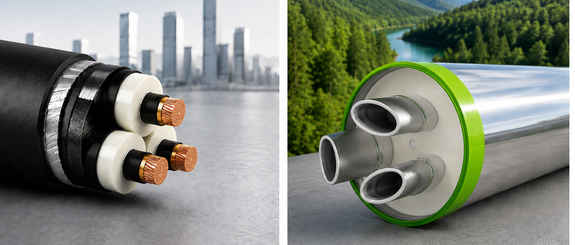
Pressurized air cables vs. XLPE cables
Comparison of transmission capacity, energy efficiency, and sustainability in medium- and high-voltage networks
XLPE cables are the established standard for underground power transmission in medium- and high-voltage networks today.
Pressurized air cables represent an innovative alternative that offers new opportunities, particularly in applications requiring high transmission capacities, long transmission distances, and sustainable infrastructure solutions.
The demands on modern power grids are increasing
The energy transition, the integration of renewable energy sources, and growing electricity demand are creating new challenges for transmission networks worldwide. At the same time, requirements for energy efficiency, reliability of supply, and sustainability are becoming increasingly important.
Today, XLPE cables are used in most medium- and high-voltage networks. However, pressurized air cables offer a new technology that combines high transmission capacity, low losses, and a fully metallic enclosure.
This comparison highlights the key differences between pressurized air cables and XLPE cables in terms of transmission capacity, infrastructure, operation, maintenance, and environmental performance.
Key differences at a glance
High transmission capacity
High current-carrying capability for demanding medium- and high-voltage networks.
PFAS- and SF₆-free
Pressurized air as a sustainable insulating medium without SF₆ or PFAS.
Integrated monitoring
Condition monitoring and pressure monitoring directly integrated into the system.
Rapid repairs
Standardized components enable repairs to be completed within a few days.
What are XLPE cables?
XLPE cables (cross-linked polyethylene cables) are currently the most widely used technology for underground high-voltage power transmission. Electrical insulation is provided by a solid insulation layer made of cross-linked polyethylene (XLPE).
Thanks to decades of operational experience, XLPE cables are considered a proven solution for utilities worldwide. However, their relatively high capacitance and the resulting reactive power currents can create technical limitations, particularly on long cable routes.

What are pressurized air cables?

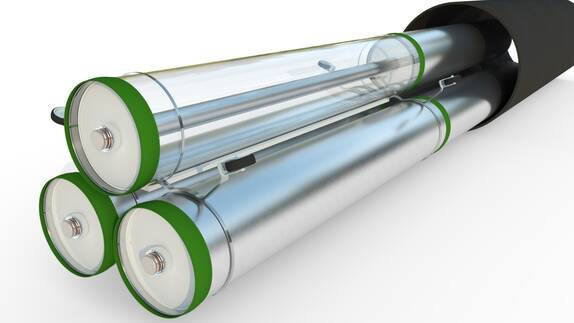
Pressurized air cables (PAC) use dry pressurized air as their primary insulating medium. The conductors are housed within a pressure-resistant aluminium enclosure that simultaneously provides mechanical protection, grounding, and electromagnetic shielding.
The technology is suitable for voltage levels ranging from 12 kV to 420 kV and can be installed in protective ducts, microtunnels, walkable cable tunnels, substations, and power plants.
Infrastructure and route integration
Utilizing existing infrastructure
Pressurized air cables can be installed in protective ducts, microtunnels, cable ducts, and walkable cable tunnels.
Thanks to their fully metallic enclosure, no additional concrete duct banks are required for cooling or fire protection. This often allows existing infrastructure corridors to be reused and can reduce construction work.
Transmission capacity
More power per transmission system
One of the key strengths of pressurized air cables is their high current-carrying capability, enabling significantly greater power transmission per system.
Typical transmission capacities:
Transmission losses
Efficient power transmission
Transmission losses have a significant impact on the economics of power networks over several decades of operation.
Typical transmission losses at 1,000 A:
Reactive power and grid stability
Less reactive power, more usable transmission capacity
Due to their insulation geometry, XLPE cables have relatively high capacitance. As a result, reactive power currents are generated, which can require additional compensation measures, particularly on long transmission routes.
Pressurized air cables have approximately five times lower capacitance. This significantly reduces both reactive power demand and charging currents.
The main reasons are the larger insulation gap provided by the pressurized air insulation and the lower dielectric constant of air (approximately 1) compared with XLPE (approximately 2.5).
Benefits for power system operation
Lower reactive power currents provide several advantages:
- Higher usable active power transmission
- Reduced charging currents
- Lower need for reactive power compensation
- Improved efficiency on long transmission routes
- Greater flexibility in network planning
As a result, pressurized air cables combine the advantages of underground transmission with electrical characteristics that are particularly beneficial for high-capacity and long-distance applications.
Monitoring and condition monitoring
Integrated condition monitoring
XLPE cable systems often rely on additional monitoring solutions such as partial discharge monitoring, temperature measurement, or sheath current analysis.
Pressurized air cables feature integrated pressure monitoring that continuously supervises key operating parameters and enables the identification of affected sections within the system.
Continuous system transparency
Because the insulating medium is continuously monitored, the operating condition of the system can be assessed throughout its service life.
This provides several advantages:
- Continuous condition monitoring
- Integrated pressure monitoring
- Early detection of anomalies
- Identification of affected sections
- Support for condition-based maintenance
- Increased operational reliability
The integrated monitoring concept makes condition assessment an inherent part of the transmission system rather than an additional external function.
Operational reliability and fire safety
Non-combustible enclosure
XLPE cables use polymer-based insulation materials.
Pressurized air cables use dry pressurized air within a fully metallic aluminium enclosure.
The design is non-combustible and is particularly suitable for applications with enhanced requirements for fire safety and operational reliability, such as tunnels, industrial facilities, and critical infrastructure.
Advantages of the enclosed metallic design
The aluminium enclosure provides multiple functions in a single system component:
- Mechanical protection
- Grounding
- Pressure containment
- Electromagnetic shielding
- Non-combustible construction
This combination supports a robust transmission system with high levels of safety and reliability, even in demanding installation environments.
Magnetic Fields
Reduced Electromagnetic Emissions
The thick-walled aluminium enclosure of pressurized air cables acts as an electromagnetic shield. Currents induced in the enclosure compensate for a large portion of the magnetic field generated by the conductors.
As a result, external magnetic fields are significantly reduced compared with conventional transmission systems.
Benefits of Electromagnetic Shielding
- Lower magnetic field emissions in the vicinity of the transmission line
- Improved electromagnetic compatibility (EMC)
- Reduced interference with adjacent technical installations and communication systems
- Easier integration into densely populated or sensitive areas
These characteristics make pressurized air cables particularly suitable for applications in urban environments, tunnels, industrial facilities, and other locations with demanding electromagnetic compatibility requirements.

Sustainability
Designed for Sustainable Energy Infrastructure
Pressurized air cables use air as the insulating medium and require neither SF₆ nor PFAS-based insulation systems.
By using air as the insulating medium, incorporating a high proportion of aluminium, and eliminating the need for SF₆ and PFAS-based insulation systems, pressurized air cables provide favourable conditions for recycling, circular economy principles, and long-term sustainable energy infrastructure. They support the requirements of modern power grids for environmental compatibility, resource efficiency, and future readiness.
Additional Benefits
- Air as a natural insulating medium
- No use of SF₆ or PFAS-based insulation systems
- Elimination of persistent fluorinated substances
- High aluminium content
- Excellent recyclability
- Low environmental impact throughout the lifecycle
- Reduced magnetic field emissions
Lifecycle Costs
Cost Efficiency Over Decades
The evaluation of transmission systems is not based solely on initial investment costs.
Energy losses, reactive power demand, maintenance requirements, repair times, and service life all influence total costs throughout the lifecycle of the asset.
Pressurized air cables particularly reduce energy losses and reactive power demand, which can contribute to lower operating costs over the long term.
Additional Benefits
- Reduced energy losses
- Lower reactive power compensation requirements
- Lower operating costs over the system lifetime
- Support for lifecycle-oriented asset management
- Long-term economic efficiency for high-capacity transmission systems
Maintenance and Repair
Rapid Restoration in the Event of a Fault
In the event of a fault, repairs to XLPE cable systems can take several weeks or even months due to jointing work and the procurement of replacement components.
Pressurized air cables are based on standardized pipe sections and bolted-free flange connections. Repairs can typically be completed within a few days.
Additional Benefits
- Short repair times
- Rapid restoration of transmission capacity
- Standardized system components
- Reduced outage durations
- Improved system availability
- Support for resilient grid operation
Limitations of Pressurized Air Cables
Every Technology Has Its Area of Application
XLPE cable systems benefit from extensive operational experience and are widely established around the world.
Pressurized air cables are a newer technology. While the number of reference projects is still smaller, type testing has already been successfully completed and initial customer projects have been implemented.
The selection of the optimal technology therefore always depends on the specific requirements of each project.
Conculsion
When Are Pressurized Air Cables an Attractive Alternative?
Pressurized air cables offer particular advantages for:
- High power transmission capacities
- High current ratings
- Long transmission distances
- Tunnel and duct installations
- Sustainable infrastructure projects
- Grid expansion in areas with limited available space
While XLPE cable systems remain a proven and widely adopted standard solution, pressurized air cables expand the range of modern transmission technologies and create new opportunities for high-capacity, sustainable, and future-ready power networks.
Technical documents
Factsheets and tecnical documents
Frequently asked questions (FAQ)
What is an XLPE cable?
What is a pressurized air cable?
What advantages do pressurized air cables offer compared to XLPE cables?
Do pressurized air cables have lower transmission losses?
Why is reactive power important on long cable routes?
For which voltage levels are pressurized air cables suitable?
Are pressurized air cables PFAS-free?
Can pressurized air cables replace overhead transmission lines?
How are pressurized air cables monitored?
How maintenance-intensive are pressurized air cables?
Are pressurized air cables recyclable?
When are pressurized air cables an attractive alternative to XLPE cables?
Do you have questions about pressurized air cables?
Technical information, factsheets, and expert support for medium- and high-voltage projects — directly from the source.