
 enEnglisch
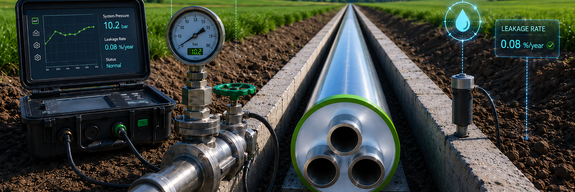
Tightness and pressure monitoring of pressurized air cables
How continuous pressure monitoring increases operational reliability and enables early condition assessment
Pressurized air cables use dry pressurized air as the electrical insulating medium. To ensure long-term insulation reliability, the systems are designed as closed and continuously monitored pressure systems.
The combination of a metallic enclosure, integrated pressure monitoring, and a high level of leak tightness enables transparent condition monitoring and supports safe operation over several decades.
The requirements for modern power grids are increasing
With the expansion of renewable energy sources, increasing electrification, and growing demands for reliability of supply, the importance of reliability and condition monitoring in energy infrastructure continues to grow.
Pressurized air cables use dry pressurized air as the insulating medium within a fully metallic enclosure. Continuous monitoring of the system pressure enables ongoing condition assessment and supports safe and efficient operation throughout the entire service life.
This page explains the fundamentals of leak tightness and pressure management, describes how the integrated monitoring system works, and highlights the benefits of a closed pressurized air system for modern energy infrastructure.
Key facts at a glance
Why is pressurized air suitable for insulation?
Air as a natural insulating medium
The electrical insulation of high-voltage systems can be achieved in different ways. Conductors in overhead transmission lines are insulated by ambient air. Underground cables are insulated using plastics such as polyethylene. Gas-insulated systems use specialized insulating gases. Dry air provides better electrical insulation properties than ambient air. In general, the dielectric strength of insulating gases increases with higher pressure.
Pressurized air cables utilize these properties and use dry pressurized air as the insulating medium between the current-carrying conductors and the metallic enclosure.
Increased dielectric strength through pressure
The insulating performance of air increases as pressure rises. Higher pressure therefore allows for smaller dimensions.
By maintaining controlled pressure within the system, dielectric strength is increased, enabling reliable operation even at high voltages. This allows pressurized air cables to be used for medium- and high-voltage applications up to 420 kV.
Natural, available, and sustainable
Unlike many other insulation systems, pressurized air cables use dry pressurized air.
This provides several advantages:
- Natural insulating medium
- Available worldwide
- No PFAS-based insulating materials
- No SF₆ required
- No specialized gas mixtures necessary
- Easy handling during filling, venting, or replacement
Foundation of a closed system
The use of pressurized air as the insulating medium forms the basis of the entire pressure management concept.
Only through the combination of pressurized air, a metallic enclosure, and continuous monitoring is a fully enclosed and controlled power transmission system created.
Closed aluminium enclosure
Mechanical protection and pressure containment in a single system
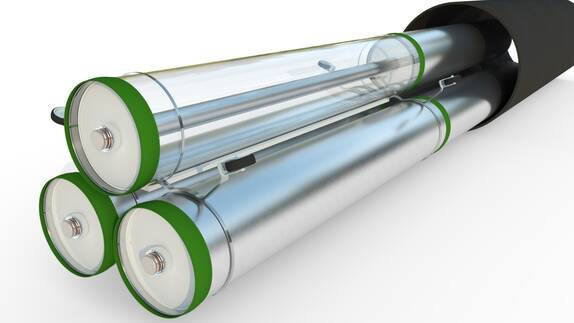
The conductors of a pressurized air cable are located within a fully enclosed aluminium enclosure.
This enclosure performs several functions simultaneously: it protects the conductors from external influences, maintains the operating pressure, ensures grounding, and reduces electromagnetic emissions.
The result is a robust and continuously monitorable power transmission system.
The foundation of high leak tightness
Unlike open transmission systems, the aluminium enclosure forms a closed pressure chamber. It protects the pressurized air from external influences and prevents the ingress of moisture or contaminants. The high level of leak tightness is a key prerequisite for long-term electrical insulation and reliable operation.
Multiple functions in a single design element
The aluminium enclosure combines several technical functions:
- Pressure containment
- Mechanical protection
- Electrical grounding
- Magnetic field reduction
- Protection against environmental influences
As a result, multiple functions are integrated into a single system component.
Protection throughout the entire service life
Throughout operation, the insulating medium remains contained, controllable, and continuously monitorable within the closed system. The enclosure protects the cable against:
- Moisture
- Corrosive influences
- Mechanical stress
- Environmental impacts
and thereby supports stable long-term operation.
The fully enclosed aluminium enclosure forms the foundation for leak tightness, pressure containment, and condition monitoring. It combines mechanical protection, grounding, and pressure management within a single system.
Continuous pressure management
Real-time condition monitoring
A key feature of pressurized air cable technology is the continuous monitoring of system pressure.
Since the pressurized air also serves as the insulating medium, the pressure condition provides important information about the state of the entire system. Changes can be detected and evaluated at an early stage.
Continuous monitoring of operating conditions
The operating pressure is continuously monitored and recorded.
This creates a transparent picture of the condition of the transmission line throughout its entire service life.
Unlike purely periodic inspections, pressure management enables continuous condition assessment during operation.
Early detection of potential changes
Even small pressure variations may indicate changes within the system.
Through continuous monitoring, such deviations can be detected at an early stage before they affect operation.
This supports condition-based maintenance and increases transparency across the entire infrastructure.
Pressure as an additional source of information
System pressure serves not only for electrical insulation but also as a diagnostic tool.
As a result, pressure management becomes an integral part of the overall system and provides valuable information for operation, maintenance, and asset management.
Benefits of integrated pressure monitoring
- Continuous condition monitoring
- Early detection of potential anomalies
- Transparent operating data
- Support for maintenance planning
- High operational reliability
- Monitoring throughout the entire service life
Pressure management is more than simply maintaining operating pressure. It continuously provides information about the condition of the system and supports safe and efficient operation over several decades
Leak tightness over long operating periods
Designed for decades of operation
Long-term leak tightness is a key prerequisite for the reliable operation of a pressurized air cable system.
Thanks to the fully enclosed aluminium enclosure, the insulating medium remains contained within the system, controllable, and protected from external influences.
This helps maintain the electrical insulation properties over long operating periods.
Protection against external influences
The metallic enclosure protects the system against:
- Moisture
- Dirt and contaminants
- Mechanical stress
- Corrosive environmental conditions
- Environmental influences
This contributes significantly to the long-term stability of the transmission system.
Monitoring instead of assumptions
A key advantage of pressure management is that leak tightness is not only ensured by design but is also continuously monitored.
As a result, information about the condition of the system is available throughout its entire operating life, and potential changes can be detected at an early stage.
Supporting condition-based maintenance
Continuous pressure monitoring enables a maintenance strategy based on actual operating data.
Instead of relying solely on time-based inspections, condition information can be incorporated into the planning of maintenance and service activities.
Benefits at a glance
- High leak tightness through a fully enclosed enclosure
- Protection against moisture and environmental influences
- Continuous monitoring of system condition
- Early detection of potential changes
- Transparent operating data
- Support for condition-based maintenance
The combination of a fully enclosed aluminium enclosure and continuous pressure monitoring enables high leak tightness over long operating periods while providing transparency regarding the condition of the system.
Benefits of integrated pressure management
More than pressure containment
In pressurized air cables, pressure management is not only used to maintain electrical insulation. Continuous monitoring simultaneously provides an additional source of information about the condition of the entire system.
As a result, pressure management becomes an integral part of operation, maintenance, and condition monitoring.
Transparency regarding system condition
The continuous recording of pressure values enables ongoing assessment of operating conditions.
Changes can be detected, documented, and analyzed, creating a high level of transparency across the entire infrastructure.
Supporting condition-based maintenance
Instead of relying exclusively on fixed maintenance intervals, actual operating data can be incorporated into the planning of maintenance and service activities.
This supports efficient use of resources and enables a maintenance strategy based on actual needs.
Benefits at a glance
- Continuous condition monitoring
- Permanent pressure monitoring
- Early detection of potential changes
- Support for fault location
- Transparent operating data
- Condition-based maintenance
- High operational reliability
- Long-term monitoring throughout the entire service life
An important building block of modern energy infrastructure
As requirements for availability, efficiency, and reliability of supply continue to increase, intelligent monitoring functions are becoming increasingly important.
The integrated pressure management system of pressurized air cables combines insulation, monitoring, and diagnostics within a single system, providing additional transparency regarding the condition of the energy infrastructure.
Pressure management is not only part of the insulation system but also a tool for continuous condition monitoring and for supporting safe and efficient grid operation.
Conclusion
Leak tightness and monitoring as part of the system concept
Pressurized air cables use dry pressurized air as the insulating medium within a fully enclosed aluminium enclosure. The combination of high leak tightness, continuous pressure monitoring, and integrated condition assessment forms the foundation for safe and reliable operation.
Unlike systems where the condition of the insulation can only be assessed indirectly, pressure management continuously provides information about the condition of the transmission line.
Greater transparency throughout the entire service life
Permanent monitoring of system pressure enables continuous condition assessment and supports condition-based maintenance.
This provides benefits for:
- Operational reliability
- Maintenance planning
- Fault location
- Availability
- Long-term grid planning
Intelligent infrastructure for modern power grids
As the demands placed on energy infrastructure continue to increase, monitoring, transparency, and condition information are becoming increasingly important.
Pressurized air cables combine electrical insulation, mechanical protection, and integrated condition monitoring within a single system, creating the foundation for high-performance and future-ready power transmission.
Final remarks
Leak tightness and pressure management are not merely technical characteristics of pressurized air cables but integral parts of the overall system concept. They enable continuous condition monitoring and support safe operation throughout the entire service life of the infrastructure.
Technical documents
Factsheets and technical documents
📄 Factsheet: Leak tightness and pressure management
Frequently asked questions (FAQ)
Why do pressurized air cables require pressurized air?
Why is the pressure monitored?
What happens if the pressure changes?
How is leak tightness ensured?
Can leak tightness be monitored continuously?
What are the benefits of pressure management?
Do pressurized air cables require SF₆ or PFAS?
Is pressurized air an environmentally friendly insulating medium?
For which voltage levels is the technology suitable?
What is the role of the aluminium enclosure?
Do you have questions about pressurized air cables?
Technical information, factsheets, and expert support for medium- and high-voltage projects — directly from the source.