enEnglisch
Layout Options for Pressurized Air Cables
The right solution for every infrastructure
Hivoduct Pressurized Air Cables (PAC) are designed to meet diverse project and infrastructure requirements. Depending on the voltage level, power transmission capacity, and available space, various installation and enclosure concepts can be implemented.
From substations and industrial plants to tunnel and infrastructure projects, Pressurized Air Cables provide a flexible, efficient, and space-saving solution for power transmission.
Why different layout options?
The requirements for modern power transmission systems vary significantly depending on the application. Voltage level, transmission capacity, available installation space, and operational and maintenance requirements all influence the selection of the most suitable installation concept.
Hivoduct Pressurized Air Cables are designed on a project-specific basis and can be configured as either single-phase or three-phase systems. This enables tailored solutions for a wide range of applications – from compact installations in substations to high-capacity transmission links over long distances.
During the planning phase, site conditions and technical requirements are carefully assessed to determine the optimal combination of enclosure design, support systems, and routing.
The following factors are considered when developing a layout concept:
- Voltage level and transmission capacity
- Available installation space
- Installation environment
- Operational and maintenance requirements
- Accessibility for inspections and repairs
- Lifecycle cost efficiency
Typical layout options
Pressurized Air Cables can be installed in a wide variety of environments. Depending on the project requirements, different installation concepts can be applied. The choice of layout influences space requirements, accessibility, as well as construction and operating costs.
The following installation configurations have proven particularly effective in practice.
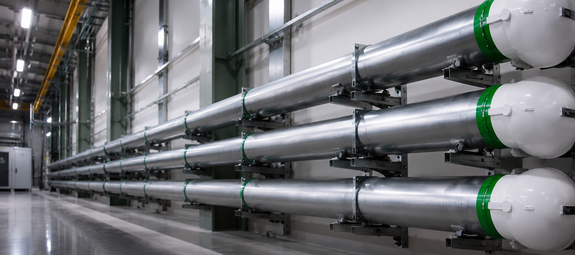
Installation on walls, ceilings and support structures

Installation in accessible tunnels

Installation in cable trenches

Installation in Microtunnels

Installation in lined bored tunnels and protective ducts

Single-Phase or Three-Phase configuration?
Singe-Phase

Three-Phase

Single-Phase or Three-Phase configuration?
Pressurized Air Cables can be designed as either single-phase or three-phase systems. The choice of configuration depends on electrical requirements, available installation space, and project-specific boundary conditions.
Both options benefit from the same technological advantages of Pressurized Air Cable technology but differ in terms of space requirements, flexibility, and installation concept.
Single-Phase systems
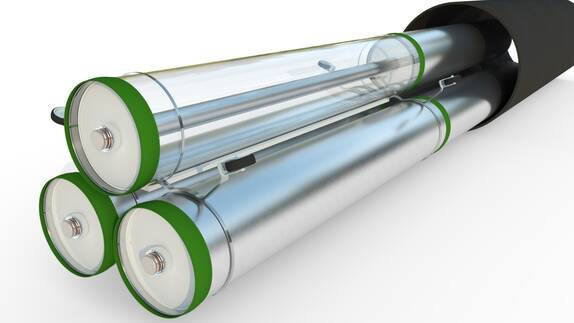
In a single-phase configuration, each phase is installed in a separate Pressurized Air Cable. The three phases are then routed together along the transmission corridor.
Advantages
- High flexibility in route alignment
- Suitable for the highest transmission capacities
- Easy adaptation to complex installation environments
- Independent arrangement of each phase
Typical applications
- Extra-high-voltage transmission links
- Long-distance transmission routes
- Tunnel installations
- Projects with increased requirements for capacity and redundancy
Three-Phase systems
In three-phase systems, all three conductors are integrated within a single Pressurized Air Cable. This results in a particularly compact solution with minimal space requirements.
Advantages
- Compact design
- Reduced installation effort
- Minimal space requirements
- Efficient use of existing infrastructure corridors
Typical applications
- Urban infrastructure projects
- Cable trenches
- Duct and microtunnel systems
- Projects with limited installation space
Space requirements and power density
Available space is becoming an increasingly critical factor in the planning of new energy infrastructure. Particularly in urban environments, along existing transport corridors, and when upgrading existing facilities, only limited space is often available.
Pressurized Air Cables enable high transmission capacities while requiring only a minimal footprint. Their compact design and efficient heat dissipation allow large amounts of power to be transmitted within a very limited space.
More power per meter of corridor width
A common metric used to evaluate different transmission technologies is Corridor Power Density (CPD). It describes the amount of electrical power that can be transmitted relative to the required corridor width.
The higher the power density, the more efficiently the available space is utilized.
Thanks to their compact design and flexible installation concepts, Pressurized Air Cables achieve particularly high power densities. This makes them especially suitable for applications where installation space is limited.
Typical power densities
Die angegebenen Werte dienen als typische Referenzgrössen. Die tatsächliche Auslegung erfolgt projektspezifisch.
Advantages in space-constrained environments
Pressurized Air Cables offer significant advantages wherever existing infrastructure corridors must be utilized or new transmission links need to be implemented in densely populated areas.
Typical applications
- Urban transmission networks
- Industrial and energy sites
- Tunnel and infrastructure projects
- Replacement of existing overhead lines
- Expansion of grid capacity without increasing corridor width
Advantages
- High transmission capacity within a compact footprint
- Efficient use of existing corridors
- Reduced land requirements
- Flexible integration into existing infrastructure
- Suitable for future capacity upgrades
Project-Specific engineering
Every power transmission project has unique requirements regarding transmission capacity, voltage level, route alignment, and available infrastructure. For this reason, Hivoduct Pressurized Air Cables are not designed as standardized products but are engineered individually for each project.
At an early stage of the planning process, technical requirements and site conditions are analyzed to determine the optimal system configuration.
Tailored to Individual Project Requirements
The system design takes various factors into account, including:
- Voltage level
- Transmission capacity
- Route length
- Available installation space
- Installation environment
- Operational and maintenance requirements
- Expansion and redundancy concepts
Based on these parameters, the cable design, enclosure system, support structures, and installation layout are optimally integrated into a unified solution.
Flexible System Configuration
Pressurized Air Cables can be adapted to a wide range of project requirements.
Possible configurations include:
- Single-phase or three-phase systems
- Installation in tunnels, trenches, or duct systems
- Wall-, ceiling-, or support-structure installation
- Project-specific anchor and guiding systems
- Different voltage levels and current-carrying capacities
This flexibility enables both compact urban applications and high-capacity transmission links over long distances.
From planning to implementation
Hivoduct supports projects from the initial feasibility study through to technical implementation. Electrical, mechanical, and infrastructure requirements are considered holistically to develop an efficient, economically viable, and future-ready solution.
Project-specific engineering ensures an optimal balance between transmission capacity, space requirements, operational reliability, and investment costs.
Developing the optimal solution together
Every project has unique requirements in terms of power transmission, infrastructure, and available space. We are happy to support you in selecting the most suitable Pressurized Air Cable configuration for your application.