
 enEnglisch
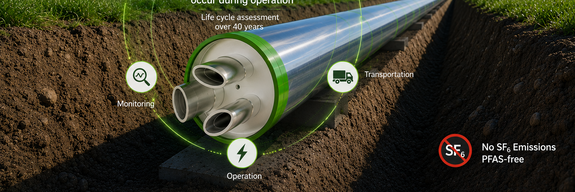
Life cycle assessment of pressurized air cables
Sustainability, energy efficiency, and environmental impacts throughout the entire life cycle of modern transmission systems
Sustainable power transmission for modern power grids
Pressurized air cables have been developed to transmit electrical energy with high power capacity, low losses, and a long service life.
In addition to technical and economic considerations, environmental impacts and sustainability aspects are becoming increasingly important in the planning of modern energy infrastructure. Life cycle assessments (LCA) enable a comprehensive evaluation of transmission systems across their entire life cycle—from manufacturing and operation through to recycling.
Pressurized air cables combine air-based insulation, large conductor cross-sections, and a high proportion of recyclable materials. As a result, they offer significant potential for reducing energy losses and CO₂ emissions throughout their entire service life.
Why life cycle assessments are becoming increasingly important
Energy infrastructure is built for decades
High-voltage transmission lines and cable systems often remain in service for 40 years or more. As a result, the long-term impacts on energy consumption, resource use, and CO₂ emissions are becoming increasingly important.
Manufacturing is only part of the picture
While construction and installation occur only once, electrical losses are generated throughout the entire operating life of a transmission system. For this reason, the environmental performance of modern transmission technologies is largely determined by their energy efficiency.
Key differences at a glance
Low transmission losses
Large conductor cross-sections reduce electrical resistance and improve energy efficiency throughout the entire service life.
SF₆- and PFAS-free insulation
Pressurized air serves as a natural insulating medium and replaces fluorinated insulating gases with high global warming potential.
High recyclability
The high aluminium content enables efficient recycling of the materials used at the end of the service life.
Sustainability over decades
Life cycle assessments consider manufacturing, operation, and recycling, enabling a comprehensive evaluation of environmental impacts over the entire life cycle.
Which factors influence the environmental footprint?
Materials and manufacturing
Every transmission system requires raw materials, energy, and manufacturing processes. Material selection and production requirements form the foundation of every life cycle assessment.
Operation over decades
Operation results in continuous energy losses throughout the entire service life. These losses often have a greater impact on the environmental footprint than the original manufacturing process.
Service life and recycling
The service life of the system and the recyclability of the materials used also influence the overall environmental performance.
Energy losses as a key influencing factor
Why losses matter
Every kilowatt-hour transmitted results in losses within the conductor system. This energy must be generated in addition to the delivered electricity and therefore has a direct impact on the carbon footprint of power transmission.
Impact over decades
Even small differences in electrical resistance can have a significant effect on the energy consumption of a transmission system when considered over several decades.
Large conductor cross-sections reduce losses
Low resistance for high efficiency
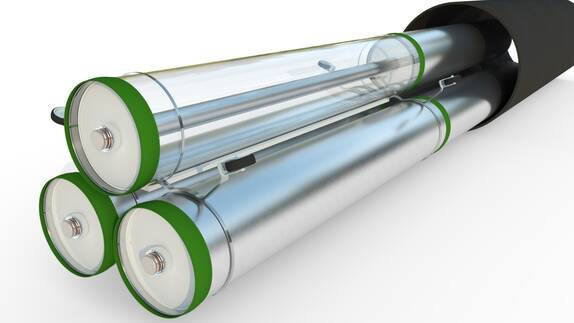
Pressurized air cables use very large aluminium conductors. The larger conductor cross-section reduces electrical resistance and therefore lowers ohmic losses.
More energy reaches its destination
Lower transmission losses not only improve energy efficiency but also reduce environmental impacts throughout the entire service life of the system.
Air instead of SF₆ and PFAS
A natural insulating medium
Pressurized air cables use pressurized air as the insulating medium and do not require fluorinated insulating gases.
A future-ready technology
As regulations on fluorinated substances continue to increase, technologies that operate without SF₆ and PFAS while still providing high transmission capacities are becoming increasingly important.
Recycling and resource efficiency
Aluminium as the primary material
A large portion of the system consists of aluminium. At the end of its service life, this material can be recycled and therefore remains part of a long-term material cycle.
Aluminium offers greater availability and a better CO₂ footprint than copper.
Sustainability throughout the entire life cycle
In addition to operational performance, the recyclability of the materials used also contributes to the overall environmental footprint of a transmission system.
Importance for future power grids
More capacity with lower energy consumption
As industry, transportation, and heating become increasingly electrified, the demand for high-capacity transmission networks continues to grow.
Sustainable infrastructure development
Future power grids require technologies that combine high transmission capacity, energy efficiency, and environmental sustainability.
Conclusion
Sustainability throughout the entire life cycle
Life cycle assessments consider not only manufacturing and installation but also the entire operating life of a transmission system.
Pressurized air cables combine low transmission losses, air-based insulation, and recyclable materials. As a result, they offer significant potential for reducing energy consumption and environmental impacts over several decades.
Technical documents
Factsheets and technical documents
Frequently asked questions (FAQ)
What is a life cycle assessment (LCA)?
Why is a life cycle assessment important for power grids?
Which factors determine the environmental footprint of a cable system?
Do pressurized air cables use SF₆ or PFAS?
Why do transmission losses affect the carbon footprint?
Why do pressurized air cables have lower losses?
Can pressurized air cables be recycled?
What role does service life play in sustainability?
Are pressurized air cables more sustainable than overhead transmission lines?
Are pressurized air cables more sustainable than XLPE cables?
Can pressurized air cables contribute to decarbonization?
Do you have questions about pressurized air cables?
Technical information, factsheets, and expert support for medium- and high-voltage projects — directly from the source.