
 enEnglisch
Pressurized Air Cables vs. Overhead Transmission Lines
Comparing Transmission Capacity, Environmental Impact, Infrastructure Requirements, and Reliability in Medium- and High-Voltage Networks
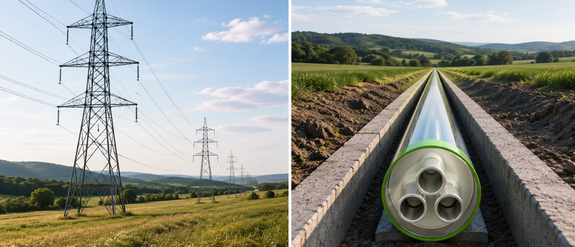
Overhead lines are currently the standard solution for power transmission networks. Pressurized air cables represent a new technology option for transmitting large amounts of electrical power.
They are particularly suitable where requirements for transmission capacity, landscape protection, reliability of supply, and infrastructure integration call for an underground solution — and where grid projects need to be completed within years rather than decades.
The requirements for modern power grids are changing
The energy transition, the integration of renewable energy sources, and rising electricity demand are creating new challenges for transmission networks worldwide. At the same time, requirements for energy efficiency, reliability of supply, landscape protection, and public acceptance are becoming increasingly important.
Overhead lines currently form the backbone of many high-voltage and extra-high-voltage networks and enable the cost-effective transmission of large amounts of energy over long distances. With pressurized air cables, however, a new technology is available that combines high transmission capacity, low losses, and fully underground infrastructure.
This comparison highlights the key differences between pressurized air cables and overhead lines in terms of transmission capacity, land use, infrastructure requirements, operation, environmental impact, and sustainability.
Key differences at a glance
Typical values according to the Hivoduct factsheet. Project-specific variations may apply.
High Transmission Capacity
High current-carrying capability for high-performance medium- and high-voltage power networks.
Sustainable Power Transmission
Pressurized air as a sustainable insulating medium, free from SF₆ and PFAS.
Protected Infrastructure
Less exposed to weather conditions, vegetation, vandalism, terrorism, and external impacts.
Minimal Land Use
Underground installation requiring only 1–2 m of width instead of 50–80 m wide overhead transmission line corridors.
What are Overhead Lines?
Overhead lines transmit electrical energy through conductors suspended and insulated on transmission towers.
For decades, they have formed the backbone of high-voltage transmission networks and enable the cost-effective transfer of large amounts of energy over long distances.
Electrical insulation is provided by the surrounding air. Due to their simple design and long operational track record, overhead transmission lines are widely regarded as a proven technology for power transmission around the world.
At the same time, overhead lines require wide transmission corridors, impact the visual landscape, and are permanently exposed to weather conditions such as storms, ice, and lightning strikes. As exposed and extensive critical infrastructure, they cannot be effectively protected.

What Are Pressurized Air Cables?

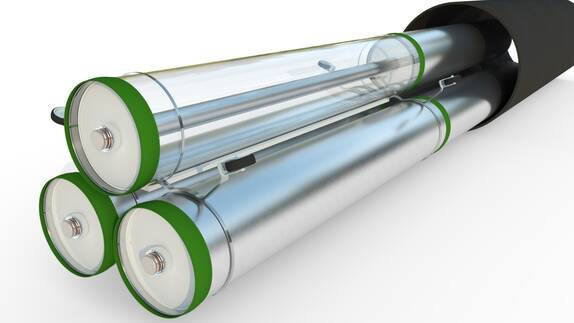
Pressurized air cables (PAC) use dry pressurized air as the insulating medium within a fully metallic aluminium enclosure.
The technology combines electrical insulation, mechanical protection, and electromagnetic shielding in a closed system and is suitable for voltage levels ranging from 12 kV to 420 kV.
Pressurized air cables can be installed in protective ducts, microtunnels, cable ducts, or accessible tunnels. They enable higher transmission capacities than overhead lines while requiring significantly less space.
Infrastructure and route alignment
More transmission capacity with less space
Overhead lines require wide transmission corridors as well as regularly spaced towers along the entire route.
Depending on the voltage level, corridor widths of approximately 45 to 75 meters are required. In contrast, pressurized air cables are installed underground in protective ducts, microtunnels, or accessible tunnels and require pipe diameters of only approximately 0.7 to 1.2 meters.
This allows existing infrastructure corridors to be utilized, reduces the impact on the landscape, and creates new transmission capacity within limited space.
Typical transmission capacities:
Typical values according to the Hivoduct factsheet.

Transmission capacity
High power transmission within a limited space
For decades, overhead lines have enabled the transfer of large amounts of electrical energy over long distances. However, they require wide transmission corridors and are affected by environmental conditions such as vegetation, wind, ice loading, and temperature.
Pressurized air cables have been specifically developed for high current-carrying capacities. Thanks to their metallic enclosure and pressurized air insulation, large amounts of power can be transmitted within a very compact footprint—particularly where above-ground transmission routes are unavailable or undesirable.
Typical transmission capacities:
Typical comparison values, depending on grid configuration and operating conditions.
Power density per meter of right-of-way
A key difference lies not only in the absolute transmission capacity, but also in the required infrastructure.
While overhead lines may require corridor widths of up to 75 meters, pressurized air cables are installed in pipe systems with diameters of approximately 0.7 to 1.2 meters.
The power density per meter of right-of-way for pressurized air cables ranges from approximately 350 MW/m at 145 kV to 1,800 MW/m at 420 kV. By comparison, overhead lines achieve a maximum of approximately 60 MW/m, while XLPE cable systems, both AC and DC, achieve a maximum of approximately 180 MW/m.
Transmission losses
Efficient power transmission
When electrical energy is transmitted, losses occur due to the electrical resistance of the conductors. These losses affect both operating costs and energy efficiency throughout the entire service life of a transmission line.
Overhead lines are already highly efficient, with losses typically in the range of only 1–2%. Actual losses depend on the voltage level, current, conductor cross-section, and line length.
Pressurized air cables always have conductor cross-sections that are 2 to 10 times larger than those of overhead lines. As a result, transmission losses are significantly reduced.
Typical power losses at 1,000 A:
Typical comparison values. Actual losses depend on system design and operating conditions.
Losses over long transmission distances
For large transmission capacities, even small differences in line losses have a significant impact on energy consumption and operating costs over several decades.
Pressurized air cables have been developed for high current-carrying capacities and can provide efficient power transmission even over long distances. At the same time, overhead lines benefit from effective heat dissipation to the surrounding air.
The optimal solution therefore always depends on the specific project requirements and grid conditions.
Reactive power and grid stability
More usable transmission capacity
For stable grid operation, not only active power but also reactive power must be considered. Reactive power places a load on transmission lines and electrical equipment without directly contributing to the supply of energy to consumers.
Due to their conductor arrangement with large phase spacing, overhead lines generate comparatively low capacitive reactive power and are therefore well suited for long-distance power transmission.
Thanks to their pressurized air insulation, pressurized air cables also exhibit very low capacitance values. As a result, reactive power currents are significantly lower than in conventional XLPE cable systems. A large proportion of the transmitted power is therefore available as usable active power.
Benefits for grid operation
Over long transmission distances, high levels of reactive power may require additional compensation equipment. Reducing reactive power improves infrastructure utilization and increases usable transmission capacity.
Pressurized air cables combine the benefits of underground installation with low reactive power requirements, enabling high transmission capacities even over long distances.
System comparison:
Overhead lines and pressurized air cables are both suitable for long-distance power transmission. Compared to XLPE cable systems, pressurized air cables exhibit lower reactive power requirements while combining this advantage with the characteristics of a fully enclosed, underground transmission system.
Reliability and availability
Protected infrastructure for critical power networks
The availability of transmission networks is becoming increasingly important. In addition to technical failures, weather-related events, natural hazards, and external impacts now play an ever-greater role.
Overhead lines are permanently exposed to environmental influences. Storms, ice loading, lightning strikes, vegetation, vandalism, and other external factors can affect operation and increase maintenance requirements.
Pressurized air cables, by contrast, are installed entirely underground and are contained within a protected metallic infrastructure. As a result, external influences are largely avoided.
Resistance to Environmental Influences:
Project- and site-specific variations may apply.
Integrated condition monitoring
Overhead lines are typically monitored through visual inspections, drone surveys, helicopter inspections, line monitoring systems, or additional sensor technologies.
Pressurized air cables feature integrated pressure monitoring. Pressure, temperature, and other operating parameters are continuously monitored. This allows deviations to be detected at an early stage, affected line sections to be precisely located, and maintenance activities to be planned based on actual system conditions.
Reliability for the power grids of tomorrow
As electrification continues to increase, the requirements for reliable power transmission are becoming more demanding.
Pressurized air cables combine high transmission capacities with protected infrastructure and integrated monitoring capabilities. As a result, they offer attractive opportunities, particularly for critical infrastructure projects, urban applications, and demanding grid expansion projects.
Magnetic fields
Reduced electromagnetic emissions
Electrical transmission systems generate magnetic fields whose strength depends on current, conductor arrangement, and distance from the transmission line.
In overhead transmission lines, magnetic fields extend over larger areas along the transmission corridor. The conductors are widely spaced, located several meters above ground, and are not shielded.
Pressurized air cables, by contrast, utilize a fully grounded, thick-walled aluminium enclosure. The conductors are arranged compactly within a closed metallic system, significantly reducing external electromagnetic fields.
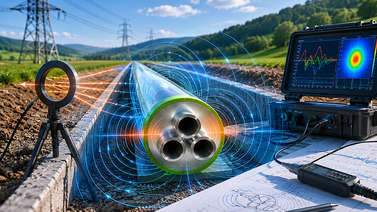
Typical magnetic field ranges :
Typical comparison values according to the Hivoduct factsheet.
Advantages of the metallic enclosure
The grounded aluminium enclosure simultaneously performs several functions:
- Touch protection
- Mechanical protection
- Grounding
- Electromagnetic shielding
As a result, external electric fields are completely eliminated, and magnetic fields are confined to a small area surrounding the transmission line.
Benefits for infrastructure and the surrounding environment
Reduced magnetic field emissions can be particularly important in the following areas:
- Residential areas
- Transportation corridors
- Industrial facilities
- Tunnel structures
- Critical infrastructure
The combination of underground installation and metallic enclosure enables power transmission with minimal impact on the surrounding environment.
Sustainability
Developed for sustainable energy infrastructure
The expansion of modern power grids requires solutions that combine technical performance with environmental compatibility.
Pressurized air cables use dry air as the insulating medium and do not require SF₆ or PFAS-based insulation systems. At the same time, they enable underground power transmission with minimal impact on landscapes and the environment.
Lower energy losses over the service life
Transmission losses affect not only operating costs but also the environmental footprint of a transmission technology.
Thanks to their large conductor cross-sections, pressurized air cables can reduce transmission losses. Over the entire service life, this can result in significant energy savings.
Use of existing infrastructure
Pressurized air cables can be installed in protective ducts, microtunnels, or existing infrastructure corridors.
This helps reduce new impacts on landscapes and the environment while making efficient use of existing transportation and utility corridors.
Resource-efficient design
The systems are predominantly made of aluminium and are largely recyclable at the end of their service life.
In addition, no large concrete duct banks are required, as is often the case with many conventional cable systems. This can reduce both material consumption and CO₂ emissions during the construction phase.
Benefits at a glance
- Pressurized air as a natural insulating medium
- No SF₆
- No PFAS-based insulation
- Reduced energy losses
- High recyclability
- Use of existing infrastructure
- Reduced impact on landscapes and the environment
- No corona noise
- Invisible power transmission
The long-term economic viability of a transmission technology is not determined solely by construction costs. Energy losses, operation, maintenance, and infrastructure requirements all influence the total cost over the entire service life of a power transmission network.
Life cycle costs
Cost efficiency over the entire service life
The evaluation of a transmission technology is not based solely on investment costs. For grid operators, factors such as energy losses, maintenance requirements, availability, and service life play a particularly important role.
Overhead lines are considered a cost-effective solution for transmitting large amounts of energy over long distances. At the same time, maintenance, corridor management, and energy losses generate ongoing operating costs over several decades.
Pressurized air cables have been developed for high transmission capacities and low losses. Thanks to their protected infrastructure, integrated condition monitoring, and efficient use of existing corridors, additional benefits may arise over the entire service life.
More than just investment costs
For infrastructure projects with service lives spanning several decades, long-term factors are becoming increasingly important:
- Energy losses
- Maintenance requirements
- Availability
- Land use
- Grid utilization
- Expandability
- Reliability of supply
The optimal solution therefore results from considering the entire life cycle rather than focusing exclusively on construction costs.
Future-Proof infrastructure
As power grids continue to expand, the requirements for transmission capacity, energy efficiency, and land use are increasing.
Pressurized air cables enable high transmission capacities within a limited footprint and can make efficient use of existing infrastructure corridors. This creates additional flexibility for long-term grid planning.
The economic performance of a transmission technology is not determined by the initial investment alone. Energy losses, operation, maintenance, and infrastructure requirements all influence the total cost over the entire service life of a power transmission network.
Limitations of pressurized air cables
Every Technology Has Its Area of Application
Overhead transmission lines benefit from decades of operational experience and today form a key component of many transmission networks.
They enable the cost-effective transmission of large amounts of energy over long distances and are widely established around the world.
Pressurized air cables represent an alternative technology that offers particularly attractive opportunities in applications requiring high transmission capacities, limited available space, environmentally sensitive landscapes, or demanding infrastructure projects.
The optimal solution therefore always depends on the technical, economic, and regulatory requirements of a specific project.
Conclusion
When Are Pressurized Air Cables an Attractive Alternative?
Today, overhead lines form the backbone of many transmission networks and enable the cost-effective transfer of large amounts of electrical energy over long distances.
However, as requirements for grid capacity, landscape protection, reliability of supply, and efficient land use continue to increase, alternative transmission technologies are becoming increasingly important.
Pressurized air cables combine high transmission capacities with underground installation, minimal space requirements, and a fully metallic enclosure. As a result, they create new opportunities, particularly where existing infrastructure corridors should be used efficiently, environmental impacts reduced, or sensitive areas protected.
Additional advantages can include reduced project planning timelines, streamlined permitting procedures, lower legal costs, and reduced administrative expenses when transmission projects are designed as pressurized air cable systems from the outset. The potential increase in property values in areas where overhead transmission lines are replaced by underground pressurized air cables may also be a relevant consideration.
Pressurized Air Cables Offer Particular Advantages in:
- Limited space environments
- Urban and densely populated areas
- Tunnel and protective duct applications
- Sensitive landscapes and natural areas
- Critical infrastructure projects
- High transmission capacity requirements
- Reduced magnetic field emissions
- Sustainable grid expansion projects
Final Remarks
While overhead transmission lines remain a proven solution for many transmission applications, pressurized air cables expand the range of modern grid technologies and open new possibilities for high-capacity, space-efficient, and sustainable power networks of the future.
Technical Documents
Factsheets and Technical Documents
Frequently Asked Questions (FAQ)
What is an overhead line?
What is a pressurized air cable?
Can pressurized air cables replace overhead lines?
Which technology requires less space?
How do the magnetic fields differ?
Are Pressurized Air Cables less affected by weather conditions?
What impact do overhead lines have on the landscape?
Are pressurized air cables PFAS- and SF₆-Free?
How are pressurized air cables monitored?
For which voltage levels are pressurized air cables suitable?
When are overhead lines the better choice?
When are pressurized air cables particularly attractive?
Do You Have Questions About Pressurized Air Cables?
Technical information, factsheets, and expert support for medium- and high-voltage projects — directly from the source.